Summary: Strength and conditioning courses in Mumbai prepare you to train athletes scientifically, covering exercise physiology, biomechanics, programme design, injury prevention, and performance testing. Career routes run through professional teams, academies, national federations, and high-performance centres, as well as private athletic training. A PGDM in high performance combines this sports science foundation with management skills, which widens the roles available. Entry salaries typically start around ₹3.5 to ₹6 lakh a year, rising substantially with experience and elite-level placement.
Strength and conditioning has moved from the margins of Indian sport to its centre. Every serious professional team now employs specialists, and the change happened within about a decade.
That shift created a profession that barely existed here before, and the supply of qualified people has not caught up with demand.
This guide covers what these courses teach, where the jobs are, what they pay, and how to choose a programme.
What does a strength and conditioning specialist actually do?
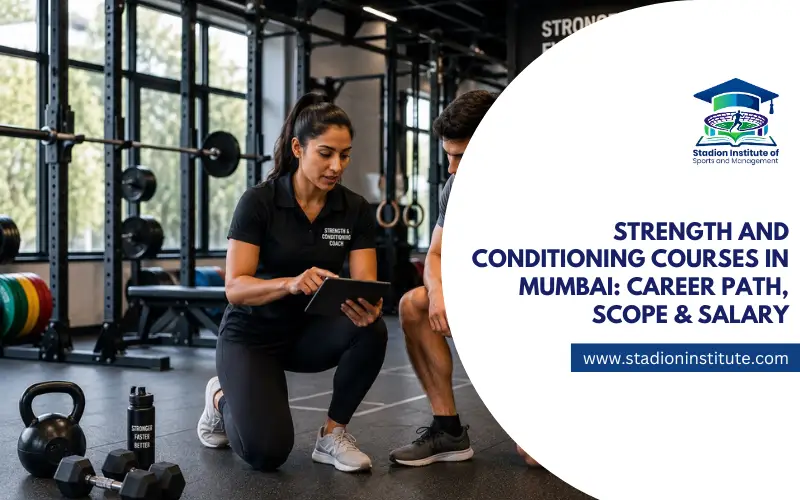
A strength and conditioning specialist designs and delivers training programmes that improve an athlete’s physical capacity while reducing injury risk. The work combines programme design, performance testing, load monitoring, and return-to-play rehabilitation in coordination with physiotherapists and coaches.
It is a science role, not a gym instructor role, and the distinction matters.
A personal trainer works towards general fitness goals. A strength and conditioning coach works towards sport-specific performance outcomes, which means understanding the physiological demands of a sport, the athlete’s competition calendar, and how to periodise training so peak condition arrives at the right time.
The day-to-day typically involves:
- Programme design: building periodised training plans around a competition schedule.
- Performance testing: measuring strength, power, speed, and movement quality against benchmarks.
- Load monitoring: tracking training load and fatigue, increasingly using GPS and force-plate data.
- Injury risk reduction: identifying movement deficits and correcting them before they cause problems.
- Return to play: rebuilding capacity after injury alongside the medical team.
Why is demand rising in India?
Because professional sport in India has institutionalised sports science, and the infrastructure to support it has been built out rapidly at both league and national level.
The national system is explicit about this. The Sports Authority of India’s National Centres of Excellence are built on five pillars including sports science, with specialists hired in exercise physiology, strength and conditioning, biomechanics, sports psychology, sports medicine and physiotherapy across the network.
Strength and conditioning is named as a distinct discipline within that structure, not folded into general coaching. That is a meaningful signal about how the role is now understood.
Alongside the elite pathway, the commercial fitness sector has expanded considerably. Deloitte and the Health & Fitness Association project India’s fitness market to roughly double, from around ₹16,200 crore in 2024 to ₹37,700 crore by 2030, with fitness facility membership rising from 12.3 million to 23.3 million.
Those two trends create different job markets. Elite sport offers fewer roles at higher specialisation; the fitness sector offers volume. A well-designed course prepares you for both.
What do these courses cover?
A serious strength and conditioning programme covers the scientific foundations alongside applied coaching. Expect exercise physiology, functional anatomy, biomechanics, programme design, nutrition, testing protocols, and injury prevention, delivered with substantial practical work.
The core components:
| Area | What it covers |
| Exercise physiology | Energy systems, adaptation, recovery, fatigue management |
| Functional anatomy and biomechanics | Movement analysis, load mechanics, technique correction |
| Programme design | Periodisation, sport-specific planning, competition scheduling |
| Testing and assessment | Strength, power, speed, and movement screening protocols |
| Nutrition and recovery | Fuelling, hydration, sleep, and recovery strategy |
| Injury prevention and rehab | Risk screening, corrective work, return-to-play protocols |
| Technology and analytics | GPS tracking, force plates, load monitoring systems |
The analytics component has become non-negotiable. Professional teams now generate substantial performance data, and a coach who cannot interpret it is limited to the roles where nobody is collecting any.
Where can the career actually take you?
Across professional teams, academies, federations, high-performance centres, and private practice. The pathway usually begins in academy or club-level work before moving to elite teams.
Realistic career routes:
- Professional team S&C coach: working with squads in cricket, football, kabaddi, or other leagues.
- Academy and youth development: building long-term athletic development programmes for junior athletes.
- National federation or high-performance centre: supporting elite athletes through the national system.
- Sports performance facility: specialist private centres serving competitive athletes.
- Individual athlete coaching: working directly with professionals on personalised programmes.
- Fitness sector leadership: technical or programme roles in the commercial fitness industry.
There is also a management route, which is where a PGDM structure changes what is available. Coaches who understand budgeting, operations, and stakeholder management move into head of performance and department leadership roles, rather than remaining in delivery indefinitely.
What can you expect to earn?
Entry-level roles in India typically start around ₹3.5 to ₹6 lakh a year, with experienced specialists at professional teams and high-performance centres earning considerably more. Senior roles at elite level command among the highest salaries in Indian sports support staff.
Some honesty about the progression is warranted.
Early roles, often at academies or clubs, pay modestly and require long hours across irregular schedules. Sport does not run on office hours, and early-career S&C work frequently means early mornings, evenings, and travel.
What changes the trajectory is specialisation and reputation. This remains a small professional community in India, where coaches become known through the athletes they work with. Progression tends to be relationship-driven and faster than in more crowded professions, but it requires patience through the first few years.
How should you choose a course in Mumbai?
Prioritise practical exposure, faculty credentials, and whether the programme connects you to actual sporting organisations. Classroom theory without applied work does not produce employable coaches.
Questions worth asking any institute:
- Who teaches the applied modules? Practitioners with team experience, or academics only.
- What practical exposure is included? Internships, live athlete work, and placement with organisations.
- What equipment do students actually use? Force plates, GPS systems, and testing tools, or theory alone.
- Where do graduates work now? Specific organisations, not general claims.
- Is management content included? This determines whether you can progress beyond delivery roles.
Mumbai is a reasonable base for this. The city hosts professional franchises across multiple sports, a dense network of academies, and a large commercial fitness sector, which together create both learning opportunities and eventual employers within reach.
The PGDM in Sports High Performance Strength and Conditioning route is designed around exactly this combination of applied sports science and management capability.
Frequently asked questions
Do I need a sports science background to apply?
Not usually. Most PGDM-level programmes accept graduates from any discipline, though a background in physical education, physiotherapy, or life sciences helps. Genuine interest in sport and willingness to engage with the scientific content matter more than prior qualifications.
How is this different from a personal training certification?
A certification teaches general fitness instruction over weeks. A full programme covers exercise physiology, biomechanics, testing protocols, and periodisation over two years, preparing you to work with competitive athletes rather than general fitness clients.
Can I work with professional teams after this course?
It is the intended pathway, though most coaches begin at academy or club level before moving to elite teams. Practical exposure and internships during the course are what make that first step realistic.
What salary should a fresher expect?
Entry-level roles typically start around ₹3.5 to ₹6 lakh a year depending on the organisation. Progression is faster than in many fields because the professional community is small, but the first two years usually involve modest pay and demanding schedules.
Is there demand outside professional sport?
Yes. The commercial fitness sector, corporate wellness, sports performance facilities, and youth academies all employ qualified strength and conditioning specialists, and this market is considerably larger by volume than elite sport.
Studying strength and conditioning at Stadion Institute
Because this field sits between sports science and management, the strongest preparation combines both rather than treating them separately.
Stadion Institute of Sports and Management in Thane West offers an AICTE-approved, AIMA-affiliated PGDM in Sports High Performance Strength and Conditioning, built around applied sports science, analytics, and industry-integrated learning, with an international pathway through the institute’s University of Miami collaboration. Students work with practitioner faculty and live project exposure rather than theory alone.
Strength and conditioning in India is a young profession with genuine demand and a shortage of properly trained specialists. It rewards people who take the science seriously and are willing to earn their reputation on the ground. To find out whether this pathway suits your background, get in touch with our admissions team today.