Summary
A high performance coaching course helps you train athletes with science, not guesswork. Stadion Institute’s programme is a 24-month PGDM in Sports High Performance Strength & Conditioning. The course suits graduates, final-year students, and people aiming for sports science roles. Final-year students can apply provisionally. It blends hybrid and on-campus learning, progressive certification, and practical exposure. The institute also lists international faculty and domestic trips.
Introduction
According to ACSM’s 2025 fitness trends report, wearable technology ranked number one, based on a survey of 2,000 clinicians, researchers, and practitioners. That shows performance training is now deeply data-driven.
That shift matters for coaches. Athletes now expect sharper feedback, better monitoring, and safer programming. A course built around strength, conditioning, and analytics is no longer optional. It is the new baseline.
This guide explains what a high performance coaching course covers, who it suits, what it costs, and how Stadion Institute structures its offering in Thane. You will also see how it compares with a strength and conditioning diploma course.
What is a high performance coaching course?
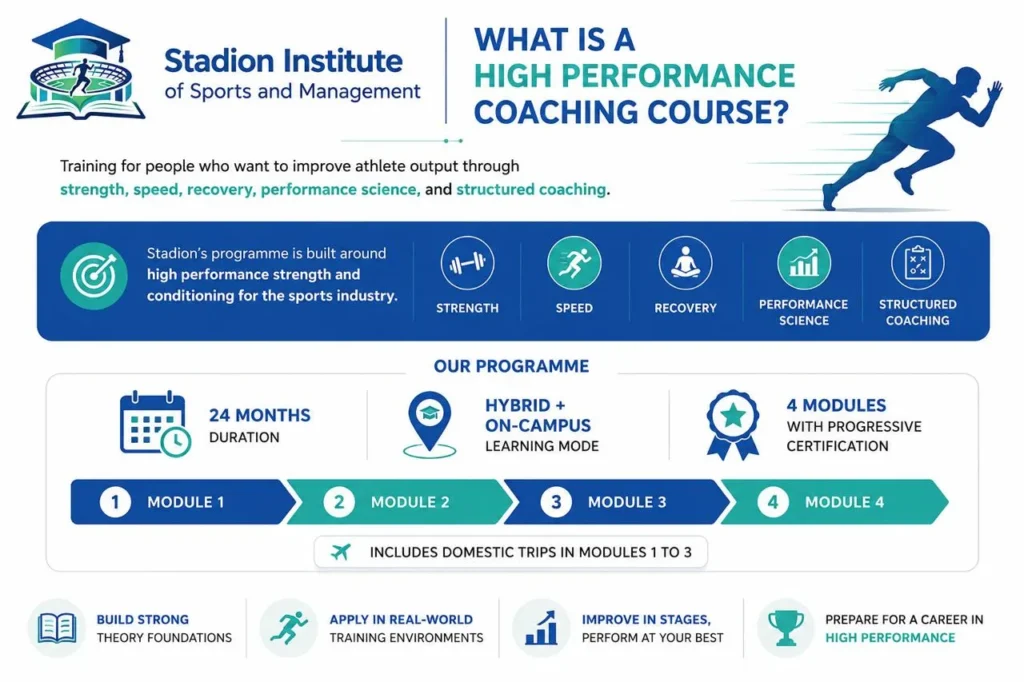
A high performance coaching course is training for people who want to improve athlete output. It focuses on strength, speed, recovery, performance science, and structured coaching. Stadion’s programme is built around high performance strength and conditioning for the sports industry.
At Stadion Institute, the course runs for 24 months. It is offered in hybrid plus on-campus mode. The structure includes four modules with progressive certification.
That format matters. It gives learners time to build theory, test it in practice, and improve in stages. The programme includes domestic trips in modules one to three.
Who should choose this course?
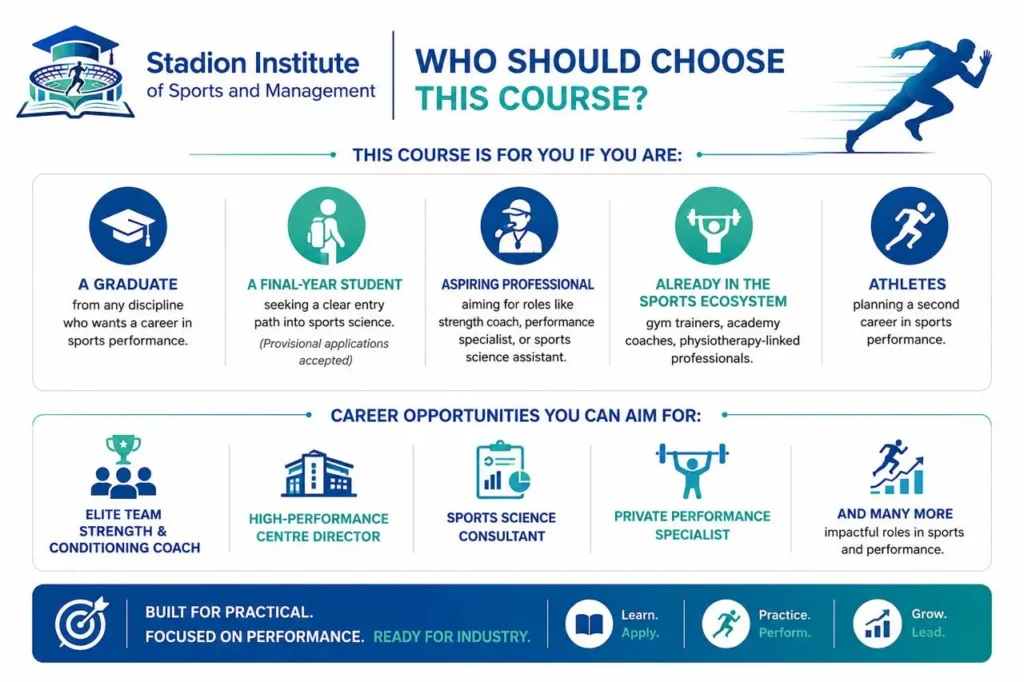
This course suits graduates who want a sports performance career. It also fits final-year students who want a clear entry path into sports science. Stadion states that graduates in any discipline can apply, and final-year students may apply provisionally.
It is a strong fit for people who want roles such as strength coach, performance specialist, or sports science assistant. Stadion lists career outcomes that include elite team strength and conditioning coach, high-performance centre director, sports science consultant, and private performance specialist.
It also suits people already near the sports ecosystem. That includes gym trainers, academy coaches, physiotherapy-linked professionals, and athletes planning a second career. The course is built for practical, industry-facing work.
What will you learn in the programme?
The programme is designed to build applied strength and conditioning skills. Its curriculum uses experiential learning, case studies, live industry exposure, and analytics-driven teaching. It also highlights Pearson-published books and an international study tour to Spain.
| Learning area | What it usually covers | Why it matters |
| Strength and conditioning basics | Load, adaptation, progression, recovery | Builds athlete performance safely |
| Sports science application | Performance monitoring, assessment, planning | Helps training decisions stay data-led |
| Coaching practice | Session design, communication, feedback | Improves real-world athlete delivery |
| Industry exposure | Mentorship, projects, trips, networking | Bridges classroom learning and jobs |
| Professional readiness | Certifications and progressive modules | Supports structured career growth |
ACSM’s 2025 trends report also supports this direction. It highlights wearable technology, mobile apps, and data-driven training as major forces in fitness and coaching. That means coaches need to read data and act on it well.
A practical example is simple. A coach working with a football academy in Thane may use workload data, recovery notes, and session feedback to adjust training. That is the kind of thinking modern performance roles now reward.
What careers can this lead to?
A high performance coaching course can open several sports performance roles. Stadion’s official page names elite team strength and conditioning coach, high-performance centre director, sports science consultant, and private performance specialist.
| Career path | Where you may work | Best for |
| Team S&C coach | Clubs, academies, leagues | People who enjoy team sport environments |
| Sports science consultant | Training centres, performance labs | Learners who like testing and analysis |
| Private performance specialist | Gyms, private clients | Coaches who prefer one-to-one work |
| High-performance director | Academies, elite centres | Experienced professionals with leadership goals |
The career market also looks better when coaching is tied to analytics. ACSM’s 2025 report says data-driven training improves real-time understanding, individualised coaching, and safer exercise decisions for special populations.
Is this the same as a strength and conditioning diploma course?
In practice, many people use both phrases for similar career goals. Stadion’s page calls the programme a PGDM in Sports High Performance Strength & Conditioning. It also describes it as an “Advanced Diploma in High Performance Strength and Conditioning in Sports” in the page copy.
| Search term | What readers usually want | What Stadion offers |
| High performance coaching course | Broader sports performance training | A 24-month PGDM pathway |
| Strength and conditioning diploma course | Applied S&C skills and job readiness | Diploma-style language within the same programme |
| Sports performance course | Coaching, science, and athlete development | Practical, industry-facing learning |
So, the real choice is not the label. It is the outcome. Do you want a course that teaches science, practice, and career structure together? Stadion’s programme is built for exactly that.
How much does it cost at Stadion Institute?
Stadion lists the fee breakup for the high performance programme clearly. The admission fee is ₹50,000. The first-year fee is ₹2,75,000. The second-year fee is ₹2,75,000. Total course fees come to ₹6,00,000.
| Fee component | Amount |
| Admission fee | ₹50,000 |
| First year fee | ₹2,75,000 |
| Second year fee | ₹2,75,000 |
| Total course fee | ₹6,00,000 |
Education loans are available through leading banks, co-operative banks, and NBFCs. It adds that scholarships of up to ₹75,000 may be available, subject to terms and scholarship test scores.
That makes the programme easier to plan for families in Mumbai, Thane, and nearby regions. A transparent fee structure helps students compare value, not just price.
People also ask
What is a high performance coaching course?
It is a programme that teaches strength, conditioning, recovery, and performance planning. Stadion’s version is a 24-month PGDM built for sports industry roles.
Who can apply for a strength and conditioning diploma course?
Graduates from any discipline can apply, and final-year students may apply provisionally. That makes the course accessible to freshers and career changers.
Is this course useful for a career in Mumbai?
Yes. Stadion is based in Thane, near Mumbai, and the programme is built for sports industry careers. Its local presence supports easier access, mentoring, and admissions.
Does this course help with modern coaching methods?
Yes. ACSM’s 2025 trends report shows coaching is becoming more data-led, with wearables, apps, and real-time training feedback shaping the field.
Conclusion
A high performance coaching course is for people who want to coach with structure, science, and purpose. It is not just about training harder. It is about training smarter, measuring better, and improving athlete outcomes.
Stadion Institute’s programme in Thane brings together a 24-month format, practical learning, progressive certification, and a clear fee structure. For learners in Mumbai and nearby cities, it offers a serious route into sports performance.